

 English
 русский
 中文简体
中文简体What is the most common use of a safety valve?
2026-02-23
Content
Direct Answer: The Most Common Use of a Safety Valve
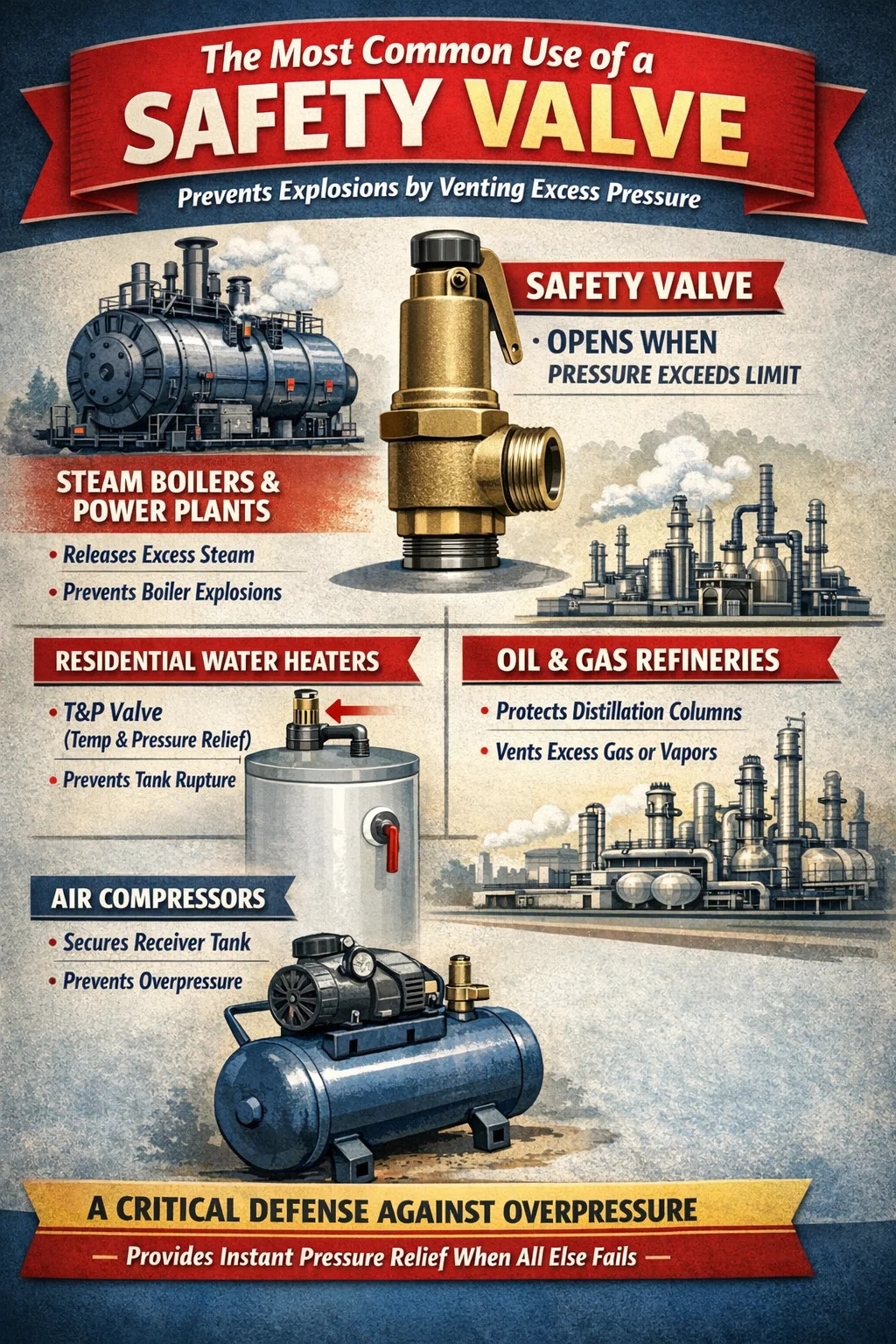
The most common use of a safety valve is to act as a fail-safe pressure release mechanism in steam boilers and thermal power generation systems. Its primary role is to prevent the catastrophic failure of pressure vessels by automatically venting excess steam or gas when the internal pressure exceeds a pre-determined limit.
Beyond heavy industry, the safety valve is most frequently encountered by the general public in domestic water heaters and pressure cookers. In these everyday scenarios, it serves as the final line of defense, ensuring that a simple thermostat malfunction does not lead to a structural rupture.
Safety Valves in Steam and Power Generation
In the world of power plants and industrial manufacturing, steam is a powerful but volatile energy carrier. Because steam expands rapidly, any blockage or heat spike can cause pressure to climb to dangerous levels within seconds.
Boiler Protection Standards
According to the ASME Boiler and Pressure Vessel Code (Section I), every steam boiler must have at least one safety valve capable of discharging the boiler's full steaming capacity. For large utility boilers, it is common to see a bank of multiple valves set at staggered pressures—for example, one set at 105% of maximum allowable working pressure (MAWP) and another at 110%.
This prevents the boiler from becoming a high-velocity projectile in the event of a pump failure or a control valve malfunction.
Widespread Use in Residential Water Heaters
If you look at the top or side of a standard household water heater, you will find a small brass component known as a T&P valve (Temperature and Pressure relief valve). This is a specialized version of a safety valve.
Preventing Residential Hazards
In a domestic setting, water heaters are typically set to 120°F to 140°F. If the heating element sticks "on," the water can reach boiling point, creating massive internal pressure.
- The safety valve is usually set to trigger at 150 PSI or 210°F.
- Without this device, a standard 50-gallon water heater has enough stored energy to level a small house if the tank ruptures.
- Over 10 million such valves are manufactured and installed annually in the US alone.
The Role of Safety Valves in Oil and Gas Refineries
Oil refineries and chemical processing plants handle volatile fluids under extreme pressures. Here, the safety valve is used to protect distillation columns, storage tanks, and reactors from "over-pressuring" during a fire or a chemical reaction surge.
| Industry Sector | Primary System Protected | Typical Medium |
|---|---|---|
| Oil & Gas | Refining Columns | Hydrocarbons/Vapors |
| Manufacturing | Air Compressors | Compressed Air |
| Pharmaceutical | Autoclaves/Sterilizers | Pure Steam |
| HVAC | Expansion Tanks | Hot Water |
In these environments, a safety valve is often paired with a rupture disc to protect the valve from corrosive materials until the very moment of a pressure emergency.
Compressed Air Systems and Small Shops
Almost every auto repair shop or woodworking studio has an air compressor. These machines rely heavily on a safety valve located on the main receiver tank.
Receiver Tank Security
The compressor pump is designed to cut out at a specific pressure (e.g., 125 PSI). If the pressure switch fails and the motor keeps running, the air tank could eventually fail. The safety valve ensures that the tank never exceeds its rated burst pressure, protecting the workshop from flying debris and blast waves.
Conclusion on Safety Valve Ubiquity
While we may not notice them, the safety valve is a silent guardian across hundreds of applications. Whether it is preventing a steam explosion in a multi-billion dollar power plant or keeping a small home water heater stable, its purpose is always the same: to provide an immediate, mechanical response to a pressure crisis when all other electronic controls have failed.